Bee eater: Difference between revisions
| Line 415: | Line 415: | ||
<br/> | <br/> | ||
[[Bee eater#Map|[Top to Map]]] <br/> | |||
[[#top|[Top to Bee eater protocol]]]<br/> | [[#top|[Top to Bee eater protocol]]]<br/> | ||
[[Protocols_web|[Back to Protocols]]]<br/> | [[Protocols_web|[Back to Protocols]]]<br/> | ||
<br/> | <br/> | ||
Revision as of 21:49, 29 November 2025
BEEEATER
NOTE
Names of sections may differ depending on the local portal. Images to describe this protocol have been taken from the German site www.ornitho.de.
Access your protocol from Menu > Take part > All my protocol > Bee-eater.
For other options, visit wiki section Web interface > Local portal > Protocols > Accessing protocols.
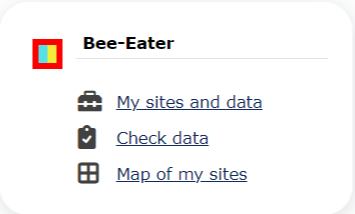
Bee eater. Menu.
Bee eater
-
1 Preparation and data
- 1.1 Add observations
- 1.1.1 Starting the protocol
1.1.2 Entering observations
1.1.3 Ending the protocol
- 1.3 Display on map
1.4 Modify the protocol
1.5 Census results
1.6 Download map
- 2 Check data
3 Map
BEEEATER Preparation and data

Bee eater. Preparation and data.
Lists all sites available to the current profile and allows entering observations, downloading printable maps and seeing results.
1 Preparation and data
-
1.1 Add observations
- 1.1.1 Starting the protocol
1.1.2 Entering observations
1.1.3 Ending the protocol
- 1.2 Results
1.3 Display on map
1.4 Modify the protocol
1.5 Census results
1.6 Download map
BEEEATER Add observations
Click on Add observations (see image below) in the site you need to enter data to.

Bee eater. Add observations.
BEEEATER Starting the protocol
Before entering observations, it is required to enter general parameters regarding the protocol. Parameters are protocol specific. Fields marked with an asterisk are mandatory.
See wiki section Web interface > Protocols > Preparation and data > Add observations > Starting the protocol for details.
When done,
Click NEXT to start entering observations.
Click NO SPECIES OF THIS PROTOCOL FOUND to end the protocol if your survey did not provide any data.
[Top to Add observations]
[Top to Preparation and data]
[Back to Bee eater protocol]
BEEEATER Entering observations
To enter observations:
1. Click on the map to indicate its position (see image below as an example). Each sighting is indicated with a different point colour. The active one is highlighted in blue and can be reposition by clicking and dragging.

Bee eater. Add observations. Position.
1. Position: Click at sighting's position. Note active position highlighted in blue (1b).
2. Scroll down to modify data or enter details (see image below). Note dot colours match those in the map above.

B eater. Add observations. Details.
2. Position: Allows correspondence between entry and the position indicated on the map above.
3. Nest information: Type number of nests in each class. In this example, Occupied nests.
4. Altitude: Altitude of observation. Automatically determined.
5. Atlas code: Choose from the expandable menu the corresponding atlas code.
6. Delete: Use bin to delete the entry.
3. Open panel to enter additional information.

Bee eater. Additional information.
7. Additional details panel: Open/close additional details panel.
8. Individuals: Type number of individuals for this observation (8b) and choose precision count from the expandable menu (8a).
9. Number of individuals per each sex/age class: Choose from the expandable menu sex and age (9b and 9c respectively) and type number of individuals belonging to this class (9a). Add a new sex/age class (9d) or delete a sex/age class (9e) if necessary.
10. Comments: Choose type of comment from the tabs (10a) and type test (10b).
11. Additional information: Check to hide your records from the public. Remember administrators will still see them.
[Top to Add observations]
[Top to Preparation and data]
[Back to Acoustic data protocol]
BEEEATER Ending the protocol
Click on I RECORDED ALL SPECIES OF THE PROGRAME to end the count.
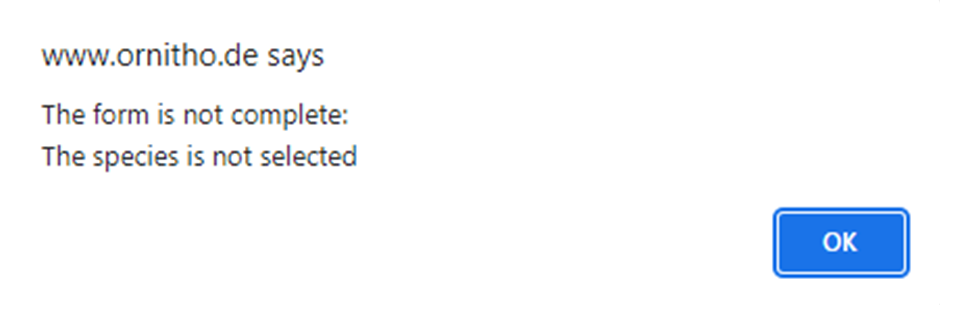
A green badge at the top will indicate your data has been saved. If there is some problem with your data, an error message will prevent you from continuing.


See wiki section Web interface > Protocols > Preparation and data > Add observations > Ending the protocol for more information.
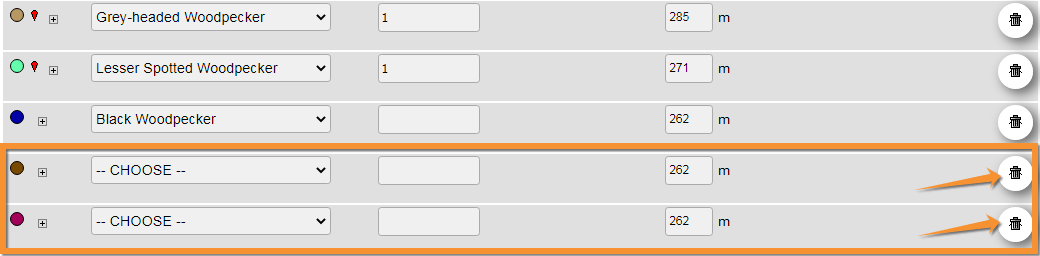
In order to submit your data properly, delete all empty entries in the list. Otherwise, you will see an error message preventing you to continue.
[Top to Add observations]
[Top to Preparation and data]
[Back to Acoustic data protocol]
BEEEATER Results

Bee eater. Results.
See some statistics about your surveys results.
Visit wiki section Web interface > Protocols > Preparation and data > Results for details.
[Top to Results]
[Top to Preparation and data]
[Back to Acoustic data protocol]
BEEEATER Display on map
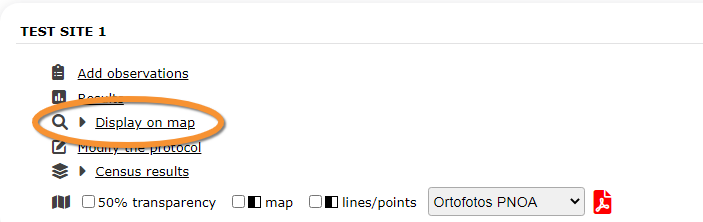
Bee eater. Display on map.
For the selected site, see the area to survey on a map. To know how to navigate the map, refer to wiki section Web interface > Navigating the map.
Visit wiki section Web interface > Protocols > Preparation and data > Display on map for details.
[Top to Display on map]
[Top to Preparation and data]
[Back to Acoustic data protocol]
BEEATER Modify the protocol

Bee eater. Modify the protocol.
Modify the site to survey.
Visit wiki section Web interface > Protocols > Preparation and data > Modify the protocol for details.
[Top to Modify the protocol]
[Top to Preparation and data]
[Back to Acoustic data protocol]
BEEEATER Census results

Bee eater. Census results.
Click on Census results to see all available years with data for this site (see image Protocol. Selecting year to visualise). Select the one to visualise.

Visit wiki section Web interface > Protocols > Preparation and data > Census protocol for details.
[Top to Census results]
[Top to Preparation and data]
[Back to Acoustic data protocol]
BEEEATER Download map

Bee eater. Download map.
Download maps ready to print.
Visit wiki section Web interface > Protocols > Preparation and data > Download map for details.
[Top to Download map]
[Top to Preparation and data]
[Back to Acoustic data protocol]
BEEEATER Check data

Bee eater. Check data.
Calendar showing visits to different sites and number of species detected.
Visit wiki section Web interface > Protocols > Preparation and data > Check data for details.
[Top to Check data]
[Back to Acoustic data protocol]
BEEEATER Map

Bee eater. Map.
Map and statistics for site.
Visit wiki section Web interface > Protocols > Preparation and data > Map for details.
[Top to Map]
[Top to Bee eater protocol]
[Back to Protocols]