SHOC Sites RNF: Difference between revisions
Created page with "SHOC_SITE_RNF <br/> <br/> Access your protocol as described in wiki section Local portal > Protocols.<br/> <br/> <center> <div class="toc" style="border-radius:5px;background-color:#ffffff;padding-left:8px;padding-right:8px;padding-bottom:8px;width:300px;"> 300px|link=https://help.biolovision.net/images/e/eb/SHOC_RNF_web_menu.png|Click image to enlarge <div class="toc" style="border-radius:5px;padding-left:15px;text-ali..." |
|||
| Line 96: | Line 96: | ||
<br/> | <br/> | ||
1: Click on add data for this census: if more than one, opens the list of the | 1: Click on add data for this census: if more than one, opens the list of the transects for that place.<br/> | ||
<br/> | <br/> | ||

Revision as of 16:30, 29 October 2025
SHOC_SITE_RNF
Access your protocol as described in wiki section Local portal > Protocols.
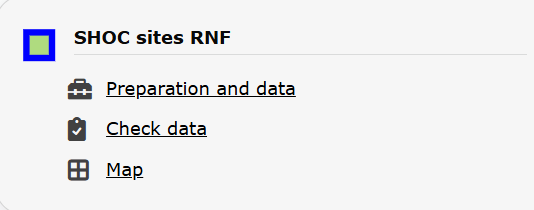
SHOC Sites RNF. Menu.
SHOC Sites RNF
-
1 Preparation and data
- 1.1 Add observations
- 1.1.1 Starting the protocol
1.1.2 Entering observations
1.1.3 Ending the protocol
-
1.2 Results
1.3 Display on map
1.4 Modify the protocol
1.5 Census results
1.6 Download map
- 2 Check data
3 Map
SHOC_SITE_RNF Preparation and data
Lists all sites available to the current profile and allows entering observations, downloading printable maps and seeing results.
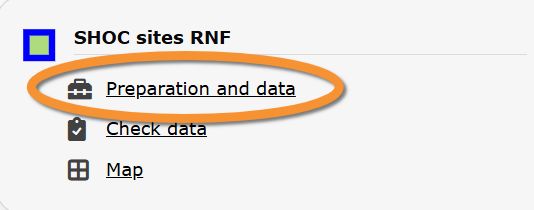
SHOC Sites RNF. Preparation and data.
2 Preparation and data
-
2.1 Add observations
- 2.1.1 Starting the protocol
2.1.2 Entering observations
2.1.3 Ending the protocol
- 2.2 Results
2.3 Display on map
2.4 Modify the protocol
2.5 Census results
2.6 Download map
SHOC_SITE_RNF Add observations
Click on Add observations (see image below) in the site you need to enter data to.

SHOC Sites RNF. Add observations.
1: Click on add data for this census: if more than one, opens the list of the transects for that place.
2: Point number
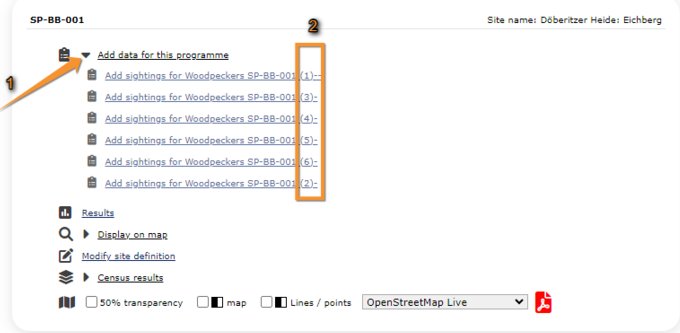
Entering data to a point. Example.
1. Add data.
2. Select point.
SHOC_SITE_RNF Starting the protocol
Before entering observations, it is required to enter general parameters regarding the protocol. Parameters are protocol specific. Fields marked with an asterisk are mandatory.
If this is not the first point you enter, you will see a summary of the information already entered on top (see image below). Click COPY THE LAST ENTRY to copy information you entered on the previous point registered. Note date and time also duplicate and you may need to correct.
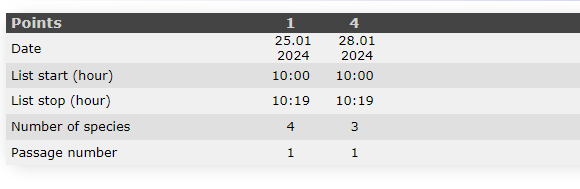
Summary of already entered points.
See wiki section Web interface > Protocols > Preparation and data > Add observations > Starting the protocol for details on how to fill in the form.
When done, click one of the options:
NEXT: to continue entering observations.
ENTRY WITH LIST OF SPECIES ALREADY OBSERVED: to continue entering observations aided with a list of species already observed.
ENTRY WITH LIST OF THE MOST FREQUENT SPECIES: to continue entering observations aided a list of frequent species.
BLANK DAILY FORM:
NO SPECIES WERE SEEN (NEXT STEP SKIPPED): to indicate the census was done was no species were observed.
CENSUS NOT DONE: to indicate this point, transect or polygon was not surveyed.
SHOC_SITE_RNF Entering observations
Enter observations as if entering a list. Interface differs depending on your choice on the previous screen.
See wiki section Web interface > Protocols > Preparation and data > Add observations > Entering observations for details.
Use the -/+ signs to open/close the additional information panel (see image below).
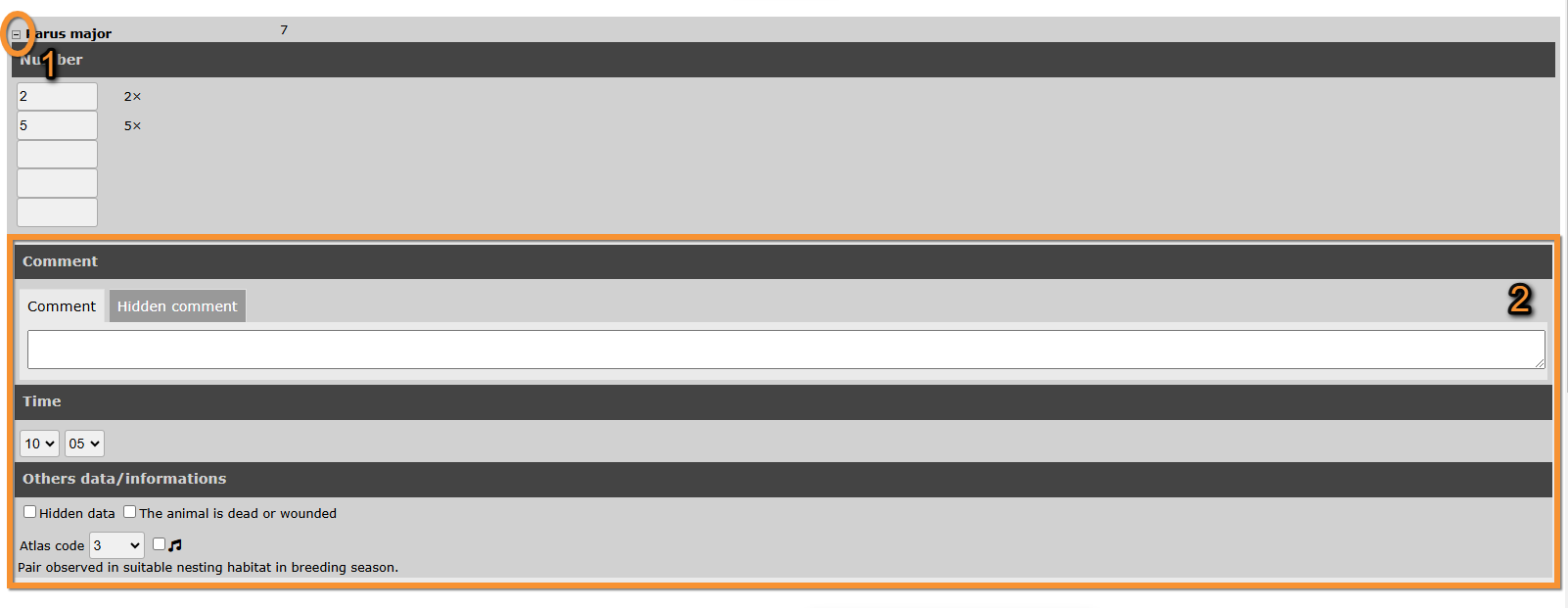
SHOC Sites RNF. Additional information panel.
1. Open/close additional information panel
2. Enter additional information if necessary.
Number: Enter number of individuals observed. Total numbers add up automatically.
Comment: Type a comment if necessary. Choose between a public and a private panel on the tabs.
Time: Choose from the expandable menu the time of the observation.
Hidden data: Check if you want to keep the observation hidden.
The animal is dead or wounded: Check if the individual is dead or wounded.
Atlas code: Choose from the expandable menu the corresponding atlas code. An explanation will show underneath once selected.
Singing: Check the cell with a musical note to indicate the individual was singing.
SHOC_SITE_RNF Ending the protocol
Click on I RECORDED ALL SPECIES OF THE PROGRAME (=FULL OBSERVATION LIST) to end the count.
A green badge at the top will indicate your data has been saved. If there is some problem with your data, an error message will prevent you from continuing.



See wiki section Web interface > Protocols > Preparation and data > Add observations > Ending the protocol for more information.
[Top to Add observations]
[Top to Preparation and data]
[Back to SHOC Sites RNF protocol]
SHOC_SITE_RNF Results

SHOC Sites RNF. Results.
See some statistics about your surveys results.
Visit wiki section Web interface > Protocols > Preparation and data > Results for details.
SHOC_SITE_RNF Display on map
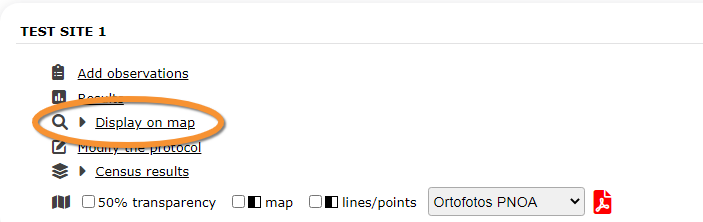
SHOC Sites RNF. Display on map.
For the selected site, see the area to survey on a map. To know how to navigate the map, refer to wiki section Web interface > Navigating the map.
Visit wiki section Web interface > Protocols > Preparation and data > Display on map for details.
SHOC_SITE_RNF Modify the protocol

SHOC Sites RNF. Modify the protocol.
Modify the site to survey.
Visit wiki section Web interface > Protocols > Preparation and data > Modify the protocol for details.
SHOC_SITE_RNF Census results

SHOC Sites RNF. Census results.
Click on Census results to see all available years with data for this site (see image Protocol. Selecting year to visualise). Select the one to visualise.

Visit wiki section Web interface > Protocols > Preparation and data > Census protocol for details.
SHOC_SITE_RNF Download map

SHOC Sites RNF. Download map.
Download maps ready to print.
Visit wiki section Web interface > Protocols > Preparation and data > Download map for details.
[Top to Preparation and data]
[Back to SHOC Sites RNF]
SHOC_SITE_RNF Check data
SHOC Sites RNF. Check data.
Calendar showing visits to different sites and number of species detected.
Visit wiki section Web interface > Protocols > Preparation and data > Check data for details.
SHOC_SITE_RNF Map
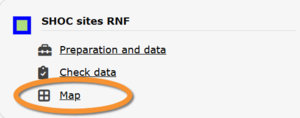
SHOC Sites RNF. Map.
Map and statistics for site.
Visit wiki section Web interface > Protocols > Preparation and data > Map for details.