Protocols: Difference between revisions
No edit summary |
|||
| Line 1: | Line 1: | ||
Protocols are standardised ways of collecting data. The methodology to follow depends on the study's goal. A country administrator will grant you access if you meet certain criteria. Not all protocols are available in all countries. See which protocols are available in which country at.... and see which criteria at... | Protocols are standardised ways of collecting data. The methodology to follow depends on the study's goal. A country administrator will grant you access if you meet certain criteria. Not all protocols are available in all countries. See which protocols are available in which country at.... and see which criteria at.... <br /> | ||
<br /> | |||
<br/> | |||
If you have access to protocols, protocol settings will appear at [[Getting_started_NaturaList#Preferences|Preferences]] (see image [[Media:Protocol.png|Protocols]] as an example), and you will access the protocol through the "Submitting data" menu (see image [[Media:Protocols menu.png|Protocols. Main menu]] as an example).<br /> | |||
<br /> | |||
==Protocol settings== | ==Protocol settings== | ||
<br/> | <br /> | ||
This section will only appear if you have access to country-specific protocols (see image [[Media:Protocol.png|Protocols]]). <br /> | This section will only appear if you have access to country-specific protocols (see image [[Media:Protocol.png|Protocols]]). <br /> | ||
<br /> | <br /> | ||
[[File:Protocol.png|center|thumb|700x700px|Protocols.]]<br/> | [[File:Protocol.png|center|thumb|700x700px|Protocols.]]<br /> | ||
<br/> | <br /> | ||
__TOC__ | __TOC__ | ||
=Territory mapping= | =Territory mapping= | ||
<br/> | <br /> | ||
===Keyboard settings for mapping=== | ===Keyboard settings for mapping=== | ||
<br/> | <br /> | ||
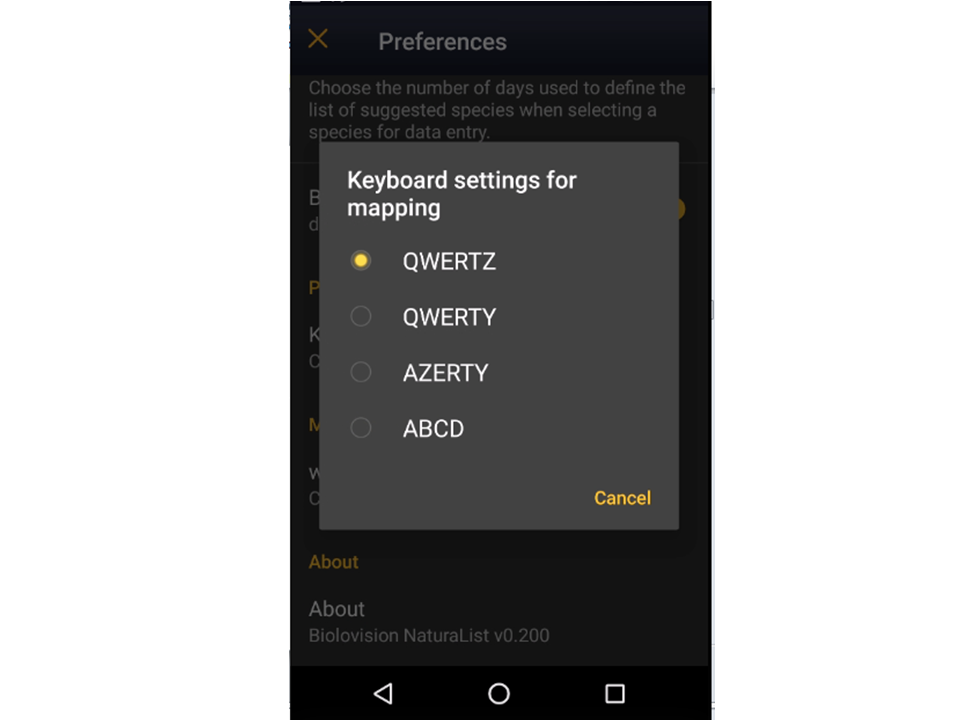
Choose one of the options to select the configuration of your keyboard (see image [[Media:Keyboard for mapping.png|Keyboard configuration for mapping]]).<br /> | Choose one of the options to select the configuration of your keyboard (see image [[Media:Keyboard for mapping.png|Keyboard configuration for mapping]]).<br /> | ||
<br /> | <br /> | ||
| Line 30: | Line 29: | ||
=Waterbird census= | =Waterbird census= | ||
<br/> | <br /> | ||
Open the menu as for [[Entering_records|'''Submitting records''']] and choose '''Waterbird census''' (see image below). <br/> | Open the menu as for [[Entering_records|'''Submitting records''']] and choose '''Waterbird census''' (see image below). <br /> | ||
<br/> | <br /> | ||
[[File:Protocols menu.png|700px|thumb|center|Protocols. Main menu.]]<br/> | [[File:Protocols menu.png|700px|thumb|center|Protocols. Main menu.]]<br /> | ||
<br/> | <br /> | ||
==Start of list== | ==Start of list== | ||
<br/> | <br /> | ||
Enter general information before starting the count (see image). Fields marked with an asterisk are mandatory.<br/> | Enter general information before starting the count (see image). Fields marked with an asterisk are mandatory.<br /> | ||
<br/> | <br /> | ||
[[File:Start of list.png|700px|thumb|center|Waterbird census. Start of list.]]<br /> | |||
<br /> | |||
:'''Comment''' <br /> | |||
You may enter a comment if you find it appropiate. <br /> | |||
<br /> | |||
:'''Important changes''' <br /> | |||
<br /> | |||
<br /> | |||
:'''Additional observer''' <br /> | |||
Indicate if you are accompanied by someone whose observations are also recorded.<br /> | |||
<br /> | |||
:'''Count type''' <br /> | |||
Tick '''roost count''' if you are counting roosting birds, or '''during day''' otherwise. <br /> | |||
<br /> | |||
:'''Count method''' <br /> | |||
Indicate if you are surveying from the ground, the air, the water, a different way, or if it is unknown. <br /> | |||
<br /> | |||
:'''Optical equipment''' <br /> | |||
Indicate which equipment you are using for the survey, if any. Note you can only choose one option. <br /> | |||
<br /> | |||
:'''Coverage''' <br /> | |||
<br /> | |||
:'''Water level''' <br /> | |||
<br/> | |||
Indicate the water level. <br /> | |||
<br /> | |||
<br/> | |||
:''' | :'''Visibility''' <br /> | ||
<br/> | |||
Indicate the approximate visibility. <br /> | |||
Indicate | <br /> | ||
<br/> | |||
:''' | :'''Waves''' <br /> | ||
<br/> | |||
<br /> | |||
<br/> | |||
:''' | :'''Conditions in general''' <br /> | ||
<br/> | |||
Choose how are surveying conditions overall regarding weather and disturbances, and indicate on next section the reason if surveying conditions are not good. <br /> | |||
<br /> | |||
<br/> | :'''Reason(s) for moderate / bad conditions''' <br /> | ||
If general conditions indicated above are noot good, click the yellow field to open and expandable menu and choose the reason (see image below). Only one option is possible: choose the one that better adjust to reality. <br /> | |||
<br /> | |||
: | [[File:Bad conditions.png|700px|thumb|center|Possible reasons for bad surveying conditions.]]<br /> | ||
<br /> | |||
<br/> | |||
:''' | :'''Additional observers'''<br /> | ||
<br/> | |||
Indicate if other oservers participated in the data collection. <br /> | |||
<br /> | |||
:'''Important changes since last count?''' <br /> | |||
:''' | |||
<br/> | |||
Indicate if there has been any major change since your previous count. <br /> | |||
<br /> | |||
<br/> | |||
:'''Record the trace''' <br /> | |||
<br/> | |||
Check if you want NaturaList to record your track. <br /> | |||
<br /> | |||
<br/> | |||
:''' | :'''Hide all records from the public''' <br /> | ||
<br/> | |||
Check if you want to keep your records privately. This will not prevent administrators to see them and contact you if necessary, but other users of NaturaList will not see your records. <br /> | |||
Check if you want NaturaList | <br /> | ||
<br/> | |||
:''' | :'''No species were seen''' <br /> | ||
<br/> | |||
Check if your survey did not provide any data. Surveys with no species are also important results! It will mean you followed the established methodology, and therefore your survey is valid, but no birds were present. They can indicate major population changes and are of extreme importance for conservation purposes. <br /> | |||
Check if your survey did not provide any data. Surveys with no species are also important results! It will mean you followed the established methodology, and therefore your survey is valid, but no birds were present. They can indicate major population changes and are of extreme importance for conservation purposes. <br/> | <br /> | ||
<br/> | |||
<center> | <center> | ||
| Line 126: | Line 141: | ||
<p> | <p> | ||
<ul> | <ul> | ||
"<i><b>My survey did not provide any data</b></i>" <br/> | "<i><b>My survey did not provide any data</b></i>" <br /> | ||
Surveys with no species are also important results! Please submit them. <br/> It will mean you followed the established methodology but no birds were present. It can be due to methodology, disturbance, pollution or other major population changes and may be of extreme importance for conservation purposes.<br/> | Surveys with no species are also important results! Please submit them. <br /> It will mean you followed the established methodology but no birds were present. It can be due to methodology, disturbance, pollution or other major population changes and may be of extreme importance for conservation purposes.<br /> | ||
</ul></p> | </ul></p> | ||
| Line 133: | Line 148: | ||
</center> | </center> | ||
<br /> | <br /> | ||
<br/> | <br /> | ||
-------------------------------------- | -------------------------------------- | ||
<br/> | <br /> | ||
Click '''Validate''' when done. <br/> | Click '''Validate''' when done. <br /> | ||
<br/> | <br /> | ||
<br/> | <br /> | ||
==Place== | ==Place== | ||
<br/> | <br /> | ||
[[File:Place.png|center|thumb|700x700px|Waterbird survey. Place.]] | |||
It opens a map with your polygon to survey (see image below). Place the red marker where the individual, or group of individuals, are observed. Note only observations within the delimited polygon can be recorded. If you have other observations that you would like to report, pause the ongoing list (pause icon on top bar, see image) and enter normally as explained in…. <br /> | |||
<br /> | |||
After entering the first record, activate/deactivate (active when orange, inactive when yellow) the summary icon to see species name and atlas code from already entered records (see image below). Click on the notebook icon at the bottom to see a list of all records on the ongoing list. <br /> | |||
[[File:Summary of observation.png|center|thumb|700x700px|Waterbird survey. Summary of observations.]] | |||
<br /> | |||
After entering the first record, activate/deactivate (active when orange, inactive when yellow) the summary icon to see species name and atlas code from already entered records (see image below). Click on the notebook icon at the bottom to see a list of all records on the ongoing list. <br/> | |||
<br/> | |||
To see how to navigate the map, see wiki section …. | To see how to navigate the map, see wiki section …. | ||
Revision as of 14:32, 1 January 2023
Protocols are standardised ways of collecting data. The methodology to follow depends on the study's goal. A country administrator will grant you access if you meet certain criteria. Not all protocols are available in all countries. See which protocols are available in which country at.... and see which criteria at....
If you have access to protocols, protocol settings will appear at Preferences (see image Protocols as an example), and you will access the protocol through the "Submitting data" menu (see image Protocols. Main menu as an example).


Protocol settings
This section will only appear if you have access to country-specific protocols (see image Protocols).

Territory mapping
Keyboard settings for mapping
Choose one of the options to select the configuration of your keyboard (see image Keyboard configuration for mapping).

Waterbird census
Open the menu as for Submitting records and choose Waterbird census (see image below).

Start of list
Enter general information before starting the count (see image). Fields marked with an asterisk are mandatory.

- Comment
You may enter a comment if you find it appropiate.
- Important changes
- Additional observer
Indicate if you are accompanied by someone whose observations are also recorded.
- Count type
Tick roost count if you are counting roosting birds, or during day otherwise.
- Count method
Indicate if you are surveying from the ground, the air, the water, a different way, or if it is unknown.
- Optical equipment
Indicate which equipment you are using for the survey, if any. Note you can only choose one option.
- Coverage
- Water level
Indicate the water level.
- Visibility
Indicate the approximate visibility.
- Waves
- Conditions in general
Choose how are surveying conditions overall regarding weather and disturbances, and indicate on next section the reason if surveying conditions are not good.
- Reason(s) for moderate / bad conditions
If general conditions indicated above are noot good, click the yellow field to open and expandable menu and choose the reason (see image below). Only one option is possible: choose the one that better adjust to reality.

- Additional observers
Indicate if other oservers participated in the data collection.
- Important changes since last count?
Indicate if there has been any major change since your previous count.
- Record the trace
Check if you want NaturaList to record your track.
- Hide all records from the public
Check if you want to keep your records privately. This will not prevent administrators to see them and contact you if necessary, but other users of NaturaList will not see your records.
- No species were seen
Check if your survey did not provide any data. Surveys with no species are also important results! It will mean you followed the established methodology, and therefore your survey is valid, but no birds were present. They can indicate major population changes and are of extreme importance for conservation purposes.
|
Surveys with no species are also important results! Please submit them. It will mean you followed the established methodology but no birds were present. It can be due to methodology, disturbance, pollution or other major population changes and may be of extreme importance for conservation purposes. |
Click Validate when done.
Place

It opens a map with your polygon to survey (see image below). Place the red marker where the individual, or group of individuals, are observed. Note only observations within the delimited polygon can be recorded. If you have other observations that you would like to report, pause the ongoing list (pause icon on top bar, see image) and enter normally as explained in….
After entering the first record, activate/deactivate (active when orange, inactive when yellow) the summary icon to see species name and atlas code from already entered records (see image below). Click on the notebook icon at the bottom to see a list of all records on the ongoing list.

To see how to navigate the map, see wiki section ….